Please review the QC test results indicated by  icon below as well as clone information before placing your order.
提供案内 (日本国内)  [open/close]
Please wait for results of QC test to be uploaded. This clone will be sequenced a portion for examination.
icon below as well as clone information before placing your order.
pUC-ELP-1 (#RDB01296)
pZF4-5 (Zinc finger) cDNA
| Alternative name | pZF4-5 |
|---|---|
| Clone info. | Mouse teratocarcinoma ELA-2 cells cDNA |
| Vector backbone | pUC119 (Plasmid) |
| Size of vector backbone | 3.2 kb |
| Selectable markers | Amp^r |
| Gene/insert name | Mouse ELP cDNA |
| Depositor|Developer | Niwa, Ohtsura | Tsukiyama, Toshio | |
| Additional map | 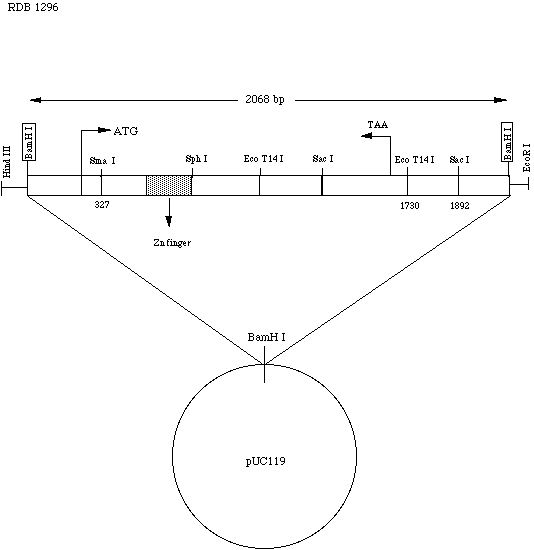
|
|---|
Distribution information
Please check terms and conditions set forth by the depositor, which are specified in the RIKEN BRC Catalog and/or Web Catalog.
| Ordering forms | Order form [Credit Card Payment  ] [Bank Transfer Payment] [Example of order form ] MTA, for use for not-for-profit academic purpose [Word ] [Example of MTA ]Please visit Information of Request for Distribution.[link] For for-profit-research purpose, please contact us. |
|---|---|
| Terms and conditions for distribution | In publishing the research results obtained by use of the BIOLOGICAL RESOURCE, a citation of literature(s) designated by the DEPOSITOR is requested. |
[open/close]| 必要書類 | 提供依頼書 [依頼書の記入例 ]提供同意書 (MTA, 非営利学術目的用)[Word ] [MTAの記入例 ]手続きの概要は、「提供申込みについて[link]」をご覧ください。営利目的利用についてはお問い合わせください。 |
|---|---|
| MTAに書く使用条件 | 利用者は、研究成果の公表にあたって寄託者の指定する文献を引用する。 |
| Catalog # | Resource name | Availability | Shipping form | Fee (non-profit org.) |
|---|---|---|---|---|
| RDB01296 | pUC-ELP-1 | Under QC test. Please contact us. | DNA solution | Please contact us. |
Please wait for results of QC test to be uploaded. This clone will be sequenced a portion for examination.How to cite this biological resource
Materials & Methods section:
| The pUC-ELP-1 was provided by the RIKEN BRC through the National BioResource Project of the MEXT, Japan (cat. RDB01296). |
Reference section:
| Tsukiyama, T., Ueda, H., Hirose, S., Niwa, O., Embryonal long terminal repeat-binding protein is a murine homolog of FTZ-F1, a member of the steroid receptor superfamily. Mol. Cell. Biol., 12, 1286-1291 (1992). PMID 1545809. |
Further references such as user reports and related articles (go to bottom)
QC test results
Please wait for results of QC test to be uploaded. This clone will be sequenced a portion for examination.
References
Original, user report and related articles
| original | Tsukiyama, T., Embryonal long terminal repeat-binding protein is a murine homolog of FTZ-F1, a member of the steroid receptor superfamily. Mol. Cell. Biol., 12, 1286-1291 (1992). PMID 1545809. |
|---|
Resource search
Link
Other resources in our bankExternal Database
Mouse ELP
Reference sequence
Tips
Featured content